

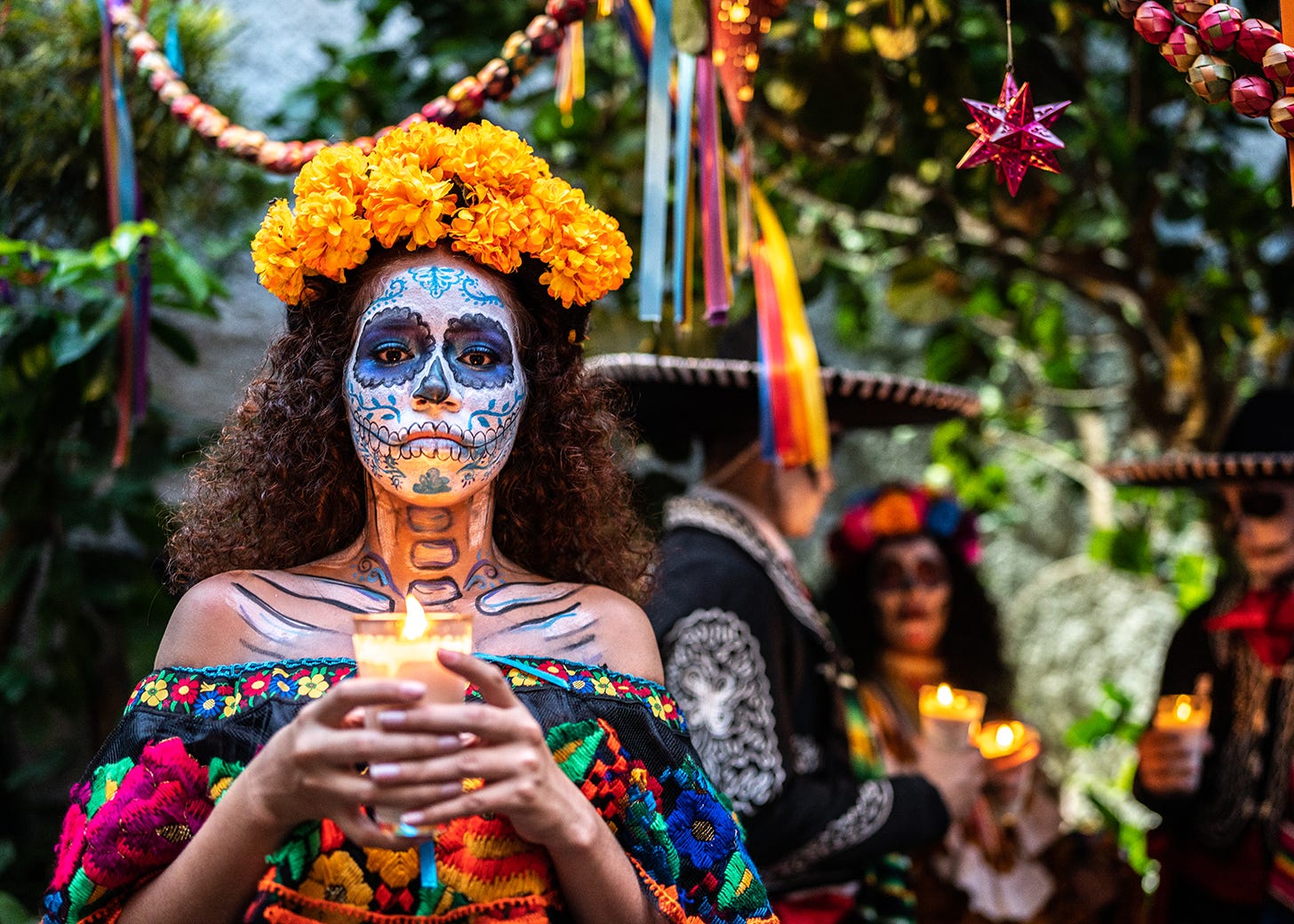
Anna (not her real name) attended one of my Day of the Dead sharing circles a few years ago. She felt a quiet but strong need to honor her Irish ancestors. Even though she didn’t know much about her ancestors or ancestry, she spoke about how moved she was after seeing how Mexican and Latinx communities remember their loved ones who have passed away.
Especially, when she saw beautiful Día de Muertos ofrendas online — colorful altars softly lit by candles and cherished photos of great-grandparents placed alongside pictures of those who had died more recently. She wanted that for her ancestors.
What moved me most was Anna’s desire to approach this tradition with real respect. She didn’t want to just copy it; she wanted to listen to and learn from the Mexican and Latinx communities, seeking ways to honor her own ancestors through these rituals. Instead of simply taking, she wanted to learn whether and how she could hold her own Day of the Dead observance that respected its original culture and spiritual meaning.
When Anna joined our group conversations, she had no idea how much they would change her and her desire to learn more about her own ancestry.
Stories emerged of Mexican American and Native-American families being uprooted and displaced from their homelands, parents being silenced for speaking Spanish or one of their Native languages, children taken from them by force, and how healing traditions were demonized and criminalized. The way their grandparents had been made to feel inferior due to their way of dressing and speaking. How their cultural and spiritual traditions faded over time. How they were made to feel ashamed of their ethnicity, of their accents. Tears came as old, ancient grief surfaced.
Euro-Americans in the group began to realize that some of the reasons they were seeking traditions outside their culture was because, without realizing it, they themselves had been quietly assimilated from one generation to the next, to the point that they no longer knew much about their ancestry, customs, or that their ancestors might have had birth, wedding, and funeral rituals unique to their land of origin.
“No Blacks, No Dogs, No Irish”
Some participants were surprised to learn that in the 1840s, newly arrived Irish immigrants faced ostracism and discrimination.
British settlers in what is now the U.S. criticized Irish immigrants for their “... supposed laziness, lack of discipline, public drinking style, Catholic religion, and capacity for criminality and collective violence. Critics often judged Irish character by supposed physical appearance.”
However, unlike African Americans, Native Americans, and Mexican Americans, the Irish could become citizens, vote, file lawsuits, and move freely from place to place.
During this same time, Native American tribes experienced forced removal from lands where they had lived since time immemorial, violent massacres, systemic efforts to destroy cultural identity, and the kidnapping of children for government and church-run “residential” schools — all due to colonization.
The more people in the group learned how colonialism, racism, and divisions created trauma patterns passed from generation to generation, the more they began to understand why their parents behaved in certain ways or suffered from mental health problems and substance misuse.
It was not that there was something inherently wrong with them or us; it was the result of our ancestors being in continual survival mode. They were resilient and persevered, and they also passed on trauma through learned unhealthy behaviors, an inability to trust, protective fearfulness, or not having the ability to parent us appropriately.
Compassion for their parents, grandparents, and themselves began to open a door to understanding how unresolved trauma can lead to abusive behaviors, neglect, or substance abuse within families. It also sparked a new determination to find help and resources to begin healing the inherited, unhealthy patterns they were uncovering.
Understanding how untold hidden history has helped erase our ancestral memories and ties to stories, songs, rituals, and ceremonies can be the impetus to reclaim, reconnect, and practice our ancestral customs.
Our collective historical traumas have made some of us unknowing perpetrators and others undeserving victims of harm, inspiring us to take an honest look at our personal and familial histories. To begin the search that will help us reconnect with our ancestors, all of our ancestors: good, bad, or indifferent.
For those who came before us and for those who come after us, we ask for forgiveness, give forgiveness, and pledge to repair and mend our relationships with our diverse communities, and to heal ourselves, our children, families, our ancestral lineage, and each other. To actively look for ways to create a healthier future in community, rather than isolation.
Doing so, we will be able to exchange generously with each other because we know who our ancestors are and where they came from, and we can practice our own cultural ways. We are rooted in our culture and our identity. We share as equals.
We become the ancestors who retrieved the soul of our lineage, our culture, our healing practices, our food, our language, and our traditions.
We become a bright and beautiful thread in the healing tapestry of generations.
Resources:
Wang, K. (2024). “It can be life-changing”: How exploring ancestry helps mental health https://www.bbc.com/future/article/20240829-healing-generational-trauma-and-mental-health-by-understanding-ancestry
Castillo, E. (2017). A Cross of Thorns: The enslavement of California’s Indians by the Spanish missions. Craven Street Books.
Reese, E. M., Barlow, M. J., Dillon, M., Villalon, S., Barnes, M. D., & Crandall, A. (2022). Intergenerational Transmission of Trauma: The Mediating Effects of Family Health. International journal of environmental research and public health, 19(10), 5944. https://doi.org/10.3390/ijerph19105944
Hankerson, S. H., Moise, N., Wilson, D., Waller, B. Y., Arnold, K. T., Duarte, C., Lugo-Candelas, C., Weissman, M. M., Wainberg, M., Yehuda, R., & Shim, R. (2022). The Intergenerational Impact of Structural Racism and Cumulative Trauma on Depression. The American journal of psychiatry, 179(6), 434–440.
Kenny, K. (2026). Irish immigrant stereotypes and American racism. Picturing U.S. History. https://picturinghistory.gc.cuny.edu/irish-immigrant-stereotypes-and-american-racism/
No Blacks, No Dogs, No Irish: a short history of discrimination against Irish migrants, https://rebelnews.ie/2023/01/18/no-blacks-no-dogs-no-irish-a-short-history-of-discrimination-against-irish-migrants/
Maestra Grace examines the colonial wounds you didn’t know you carry in her exclusive online event with The Shift Network. Learn more here.
Maestra Grace Alvarez Sesma is of Yaqui descent and born in Mexico. She was called to the path of curanderismo (a traditional Mexican Indigenous healing system) in childhood during which she was profoundly influenced by the work of one of her aunts, a curandera; an uncle who was a well-known huesero, a traditional Latin American healer specializing in treating bone, joint, and muscle issues through hands-on, ancestral techniques, and her mother’s remedies that were part of her family’s daily life. Grace was visited in dreams by Our Lady of Guadalupe and a group of Indigenous Grandmothers dressed in the traditional clothing of different Native tribes of the Americas, who urged her to return to Indigenous healing ways and help bring forth the call from Mother Earth for a return to Indigenous values and the protection of the land, water, and holy places. Grace serves her community as a practitioner of Traditional Indigenous Medicine, a cultural educator, and a social justice advocate. Her work centers on the preservation and application of Indigenous knowledge systems in contemporary settings, with a focus on healing, education, and cultural revitalization. Find her at curanderismo.org and gracesesma.com