

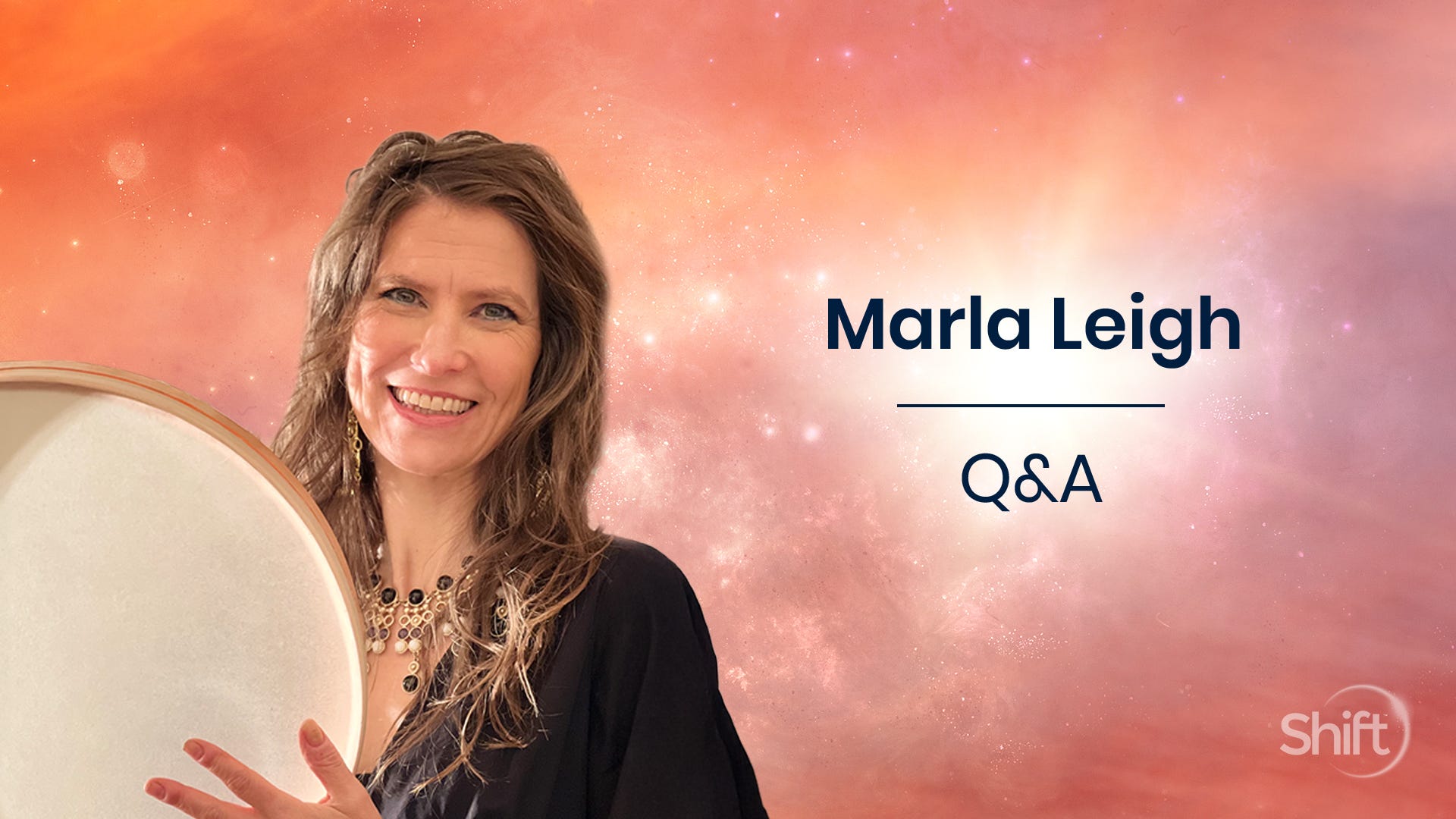
Marla Leigh is a classically trained musician and one of the world’s few professional female frame drummers. An award-winning percussionist and flautist, she’s a trailblazer in bringing the ancient art of frame drumming to modern audiences around the globe.
The first time you picked up a frame drum, did you know this would be so important in your life?
I knew music would always be central to my life — but I didn’t know it would be the frame drum. Still, the first time I heard it played, I felt it in my body. I got chills.
I had just begun my undergraduate studies in Jazz Flute and Composition at the California Institute of the Arts (CalArts) when John Bergamo — who later became my first mentor — performed on the frame drum in a concert. The sound was simple, yet ancient. Direct. It seemed to bypass thought and go straight to my heart. It was love at first sound. I knew I needed to learn it.
After that concert, John invited me to study with him, and what followed was an unfolding — a widening of my musical world. I immersed myself in the art of percussion, studying African, Indian, and Balinese drumming, and eventually earned my MFA in Percussion from CalArts.
I remain deeply grateful for my teachers. I studied for over a decade with John Bergamo and Glen Velez — two pioneers of the modern frame drum — and also received guidance from Layne Redmond, all central figures in the contemporary revival of the instrument.
Over time, I came to understand that the frame drum was more than an instrument for me. It became a steady companion — shaping my creativity, sharpening my listening, and grounding me through every chapter of my life.
Is there a special connection between women and drumming?
Historical imagery from ancient Mesopotamia, Greece, Turkey, and Egypt shows women playing the frame drum as early as the 6th millennium BCE. In many of these cultures, the instrument was present in communal life and ceremonial settings.
Today, the frame drum is embraced by people of all genders. Two of my primary mentors — Glen Velez and John Bergamo — were central figures in the modern revival of the instrument.
Studying the frame drum connects us to a long and evolving lineage. It’s an instrument with deep history — and it remains fully accessible to anyone who feels called to learn it.
What are the essential things you’d like people to understand about your work and your mission?
First and foremost, learning music is accessible. It’s not limited by age, background, or identity. You don’t need to consider yourself “musical” to begin.
My mission is to make learning to drum supportive, engaging, and genuinely enjoyable. I want students to experience success early and build real skill from there. There are also well-documented benefits to maintaining a drum practice; even a few minutes of focused drumming can increase alertness, coordination, and mental clarity.
I also love sharing my music and witnessing how others receive it. In addition to teaching, I’ve been composing since I was a young girl. I released my debut album, Rhythms of Tof Miriam, in 2020, and I’m VERY excited to release my next studio album later this year.
Whether through teaching or composing, I hold one core belief: music is a universal language that fosters connection. That principle guides everything I do.
What do people in your life think about what you’re doing?
They feel the devotion. After 31 years of teaching, they know this isn’t just a job for me. It’s something I’ve committed to with consistency, discipline, and heart. I’m grateful that music still brings me joy every single day.
I started music lessons at three years old and, truthfully, I never really stopped. Even after college, I kept studying — frame drum, tabla, music technology. I’ve always loved the process of learning and refining.
That steady practice keeps me grounded. It keeps me growing. And it reminds me that mastery isn’t about arriving — it’s about staying curious.
How does your teaching method help change people’s perceptions?
Over the years, I’ve met so many students who arrive carrying old music stories — “I have no rhythm,” “I’m not musical.” I understand that story. Many of us were handed it early.
So I built a way of teaching that gently helps people rewrite that narrative.
My approach is structured and supportive, but it’s also kind. We learn through listening and repetition, one clear step at a time — not through pressure or performance. When people realize rhythm is something that develops with practice, not something you’re born with, you can almost see their shoulders drop.
As their timing steadies and their coordination improves, confidence grows naturally. And that confidence doesn’t stay in the drum — it carries into the rest of their life.
What’s different about how you see the world?
I notice rhythm everywhere — in speech, in movement, in silence between words.
Rhythm reveals when something is rushed, grounded, or out of sync. Just as a metronome teaches steadiness in music, it teaches patience and attentiveness in life. Over time, that way of listening becomes a way of living. I try to move through the world the same way I approach music: listening first, then responding with intention.
How does drumming nourish or challenge you personally?
Drumming brings me back to center. It quiets distraction and requires full presence.
It also challenges me. Precision matters. Listening matters. Refinement matters. Improvisation, especially, demands growth. I practice creating new rhythmic ideas regularly, rather than repeating what is familiar.
The drum offers both structure and freedom — and that balance continues to shape me as a musician and as a person.
Can complete beginners really learn to drum?
Absolutely. Rhythm is deeply human. Before we ever speak, we hear a heartbeat. When someone says, “I have no rhythm,” I gently question that belief. If you can clap a steady beat, you can begin.
My method is progressive and clearly structured. Students develop timing, coordination, and musical confidence at a pace that feels steady and achievable. Most people do not lack rhythm — they simply haven’t been shown how to cultivate it.
What can someone do with their newfound drumming skills?
The possibilities are meaningful and varied. Students have drummed with grandchildren, bringing rhythm into intergenerational connection. Others incorporate drumming into therapeutic settings or psychotherapy sessions. Some begin composing or performing original music. Others form local community circles.
For many, it becomes a simple and fun daily coordination and focus practice — keeping the hands active, the mind engaged, and creativity alive. One student began at 88 years old. After several months of steady practice, she reported improved hand coordination and a renewed sense of purpose.
Drumming can be creative, restorative, social, or deeply personal. It is a skill that can grow with you for a lifetime.
Marla Leigh holds bachelor and master’s degrees in flute, percussion, and composition from the California Institute of the Arts, and has studied at Ali Akbar College in San Rafael and the Bhavan Center in London, England. She’s shared the stage with many artists, including Grammy award-winner Glen Velez, John Bergamo, and Pandit Swapan. She is the CEO of Frame Drum Academy, and has released two albums. Her music has been featured on Hala Khouri’s Yoga for Stress Release, Janet Stone’s yoga application, and films Bold Native and The Cellist. She offers retreats and clinics around the world. Find her at framedrumacademy.com
.