

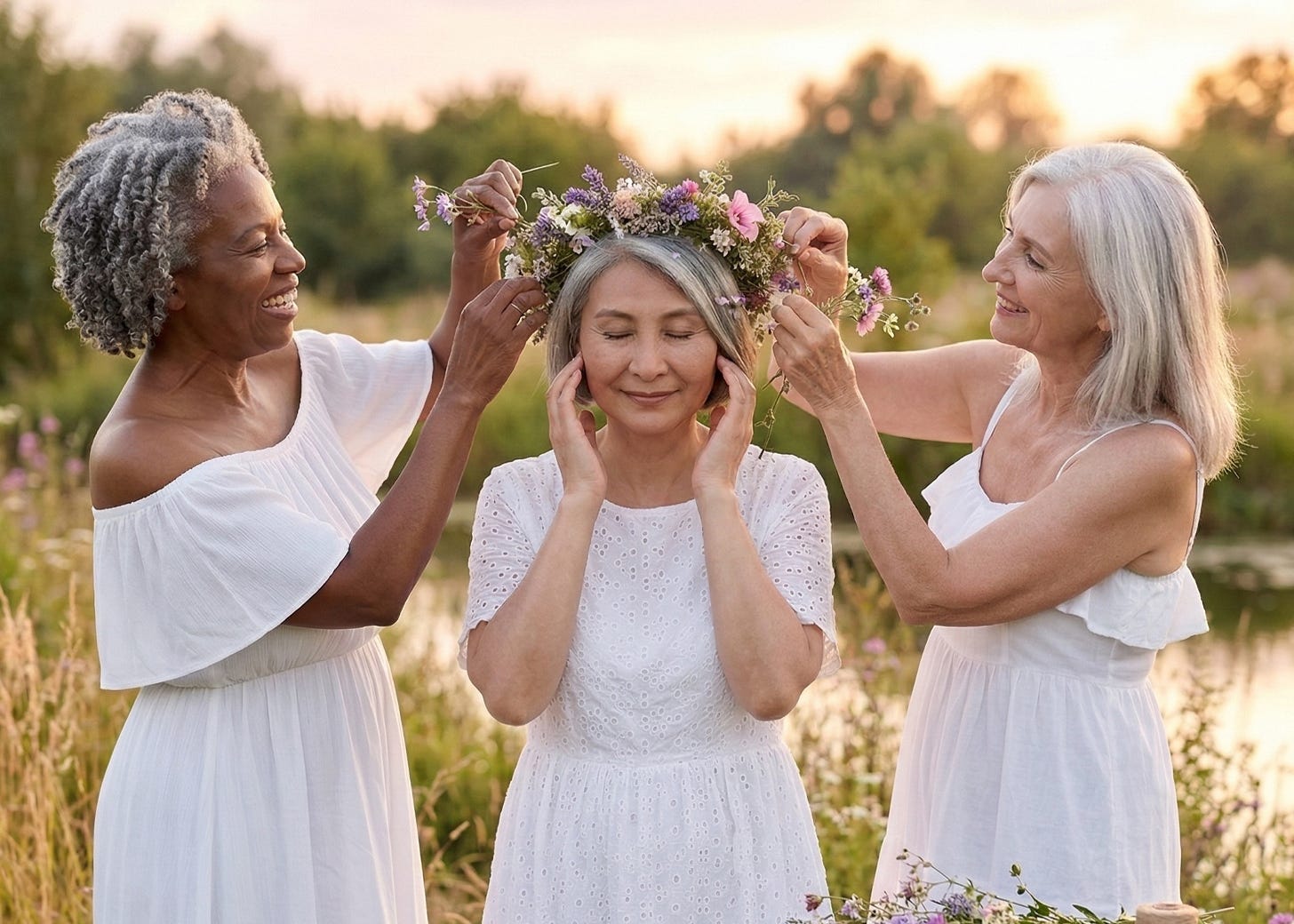
by Jane Hardwicke Collings
There is a kind of forgetting that has happened in our culture.
Not a sudden loss, but a gradual drifting away from ways of knowing that once guided how we lived, how we cared for ourselves, and how we understood our place in the world.
Many women feel this without necessarily having words for it — a sense that something is missing, something that would help make sense of their bodies, their lives, and the changes they move through.
And yet, the clues for how to live in a more connected, sustainable, and meaningful way are still here.
There are clues hiding in plain view for how to live a sustainable, earth-honoring life — and one of the most overlooked places we can find them is in the menstrual cycle.
For most women, this idea is unfamiliar. We have been raised in a culture that largely ignores, suppresses, or even rejects the menstrual cycle and the wisdom it carries. This long-standing taboo has distanced women from their bodies, and from the natural rhythms that shape our lives.
And when we reject the cycle, we reject the body. It is the same thing.
When we look more closely, we begin to see that the way women’s bodies are treated mirrors the way the Earth is treated. The same pattern runs through menstruation, childbirth, and menopause. It is often said that how a culture values the feminine is how it values the Earth — and we can see the truth of that reflected everywhere.
The menstrual cycle offers a simple but profound teaching: honor the rest phase — or there will be consequences.
When a woman does not rest, nourish herself, and respond to her body’s needs during her bleeding phase, the rest of her cycle is affected. This often shows up as discomfort, imbalance, or distress. The cycle is not broken — it is responding.
This wisdom extends far beyond the body.
We live in a culture that prioritizes constant growth, productivity, and output. There is little space for rest or renewal — yet these phases are essential to any living system. Without them, depletion is inevitable.
The cycle teaches us another way: to move with the phases of life rather than override them. Everything in life moves in cycles. The day moves from light to dark. The moon waxes and wanes. The seasons shift from growth to harvest to stillness. A woman’s body follows its own rhythmic pattern. And a human life unfolds through distinct stages or life seasons.
Each of these cycles reflects the same pattern: birth, growth, full bloom, harvest, decay, death, rebirth. There is an intelligence to cycles and our body’s cyclical nature. When women begin to understand this, something shifts.
Life starts to make more sense. There is less self-judgment, less confusion, and less pressure to keep going in ways that are unsustainable. Instead, there is an opportunity to align with what is actually happening, internally and externally.
One of the simplest and most powerful ways to develop cycle intelligence and begin reconnecting with this wisdom is through menstrual cycle charting. Tracking the body’s rhythms reveals patterns in energy, creativity, mood, and desire. Over time, this becomes a kind of map — a way of understanding oneself that is grounded in lived experience.
If there were such a thing as a woman’s body owner’s manual, this would be one of the first instructions.
At the heart of my work is the understanding that a woman’s life is shaped by her rites of passage. These are the moments when we change from one version of ourselves into another — menarche, sexual initiation, childbirth, menopause, and beyond.
They are not small events. They are transformational thresholds.
And yet, in our culture, these transitions are rarely recognized, supported, or honored in meaningful ways. What happens at a rite of passage matters deeply. It teaches us, often unconsciously, what is expected of us in the next stage of life, how we are valued, and how we must behave to belong.
When rites of passage are ignored, rushed, or stripped of meaning, they can become confusing or even wounding experiences. But even then, they are not without purpose. They become what I call soul-crafting opportunities — invitations to understand ourselves more deeply, to recognize the patterns that have shaped us, and to consciously choose a different way forward.
One of the most powerful questions a woman can ask is: “What did this experience teach me about being a woman?” And then: “Is that the message I want to continue living by?”
It is never too late to reclaim a rite of passage. In fact, this is a lifelong process.
We begin by understanding the impact of what happened, and how it shaped our beliefs, behaviors, and sense of self. From there, we can consciously create new experiences that honor who we are and who we are becoming.
This might look like creating a personal ceremony, gathering in circle with other women, reflecting on past transitions with compassion, or offering new messages to younger parts of ourselves.
Rites of passage are not only personal. They build community. They create connection, belonging, and shared meaning. And when they are honored, they restore something that has been missing for many women: a sense of being seen, supported, and initiated into each stage of life.
We are living in a time of profound change. Many of the systems that have shaped our world are showing their limits. The model of endless growth and control is no longer sustainable, and the consequences are visible everywhere — especially in the state of women’s health and wellbeing.
Menstrual cycle pathology continues to rise. Unnecessary intervention in childbirth, and the resulting birth trauma, increases year by year. Menopause is increasingly medicalized. Women are being led to believe that their natural bodily processes are faulty and in need of fixing.
This is deeply demoralizing. It turns essential, intelligent functions of the body into problems to be feared, leaving women disconnected from — and even resentful of — their own bodies. And it comes at a cost — emotionally, physically, and financially.
What is being called for now is something different.
We need women who are resilient.
Adaptable.
Grounded.
Connected to both their inner world and the natural world.
This is not something we have been taught to do or become. The capacity for this kind of change emerges through inner work — through understanding how we have been shaped, releasing what no longer serves, and reconnecting with our own nature.
When women do this work, something shifts.
They begin to trust themselves.
They begin to see clearly.
They begin to act from a place of embodied knowing rather than external pressure.
And this is where menopause becomes particularly important. Because menopause is not simply an ending. It is an initiation into the Wise Woman stage of life — a time of clarity, authority, and perspective. When supported and understood, it prepares women to step into roles of leadership, guidance, and contribution in their communities.
I live in the bush in the Southern Highlands of New South Wales, at the edge of a vast forest. Living this way brings me into daily relationship with the cycles of the Earth — the seasons, the weather, the movement of life around me. It is quiet, spacious, and deeply grounding.
There is a kind of conversation that happens when you live close to nature.
You begin to feel the shifts.
You notice the changes.
You respond differently.
And this way of living is not separate from my work. It is the foundation of it. Because ultimately, the invitation is simple: to return to a way of being that honors the cycles of life.
To rest when it is time to rest.
To grow when it is time to grow.
To harvest what has been lived.
And to allow what is complete to fall away.
This is how regeneration happens — in the body, in our lives, and in the world.
Today there is a growing recognition that the menstrual cycle, childbirth, and menopause are not just inconvenient, messy, and risky biological events, but are profound life transitions that deserve understanding, support, and meaning.
When women are given a framework for these transitions — one that includes the body, the psyche, their lineage, and the spirit — everything begins to change.
This is the work I have devoted my life to.
Jane Hardwicke Collings is an author, teacher, and speaker on women’s mysteries, and the founder of the School of Shamanic Womancraft, an international women’s mystery school now in its 16th year, training hundreds of students worldwide. A retired registered nurse and former home birth midwife with 30 years of experience, she is an expert in menstrual cycle awareness, rites of passage, childbirth, menopause, and sacred feminine knowledge. Jane is also the creator of the Wisdom of the Cycles map; a sought-after contributor to podcasts, summits, and educational programs, and a facilitator of transformation using body wisdom, nature connection, and ancient spiritual practices. Find more about Jane here.