

by Anodea Judith, PhD
What I love about the chakra system is that it covers all the dimensions of human experience:
Our embodied reality here on the earth plane
Our emotional and psychological development, along with its gifts and wounds
Our relational realm of intimacy and communication
The spirituality of reaching higher states of consciousness
There are few systems that embrace all three of these realms: Body, Psyche, and Spirit. Let’s look at how this plays out.
Yoga takes the important step of bringing the body into spirituality.
Through physical postures and breath practices (as well as guidelines for behavior from the Yamas and Niyamas), yoga is an embodied spiritual practice. But it tends to ignore our psychological wounds, advising us to transcend them instead.
This often becomes what psychologists call a “spiritual bypass,” where people try to reach enlightenment without dealing with their psychological baggage, which eventually holds them back, or comes out in shadow form.
Somatic therapies bring the body into psychological healing, yet often ignore spirituality.
Bioenergetics, Somatic Experiencing, Neurosomatic therapy, breathwork, some types of massage, and many other disciplines recognize that psychological issues are stored in our tissues. Behaviors and defenses developed in childhood — as survival strategies — become lodged in our physiology, creating lifelong imbalances.
Muscular tension, and even illnesses, can be the result of unresolved mental and emotional issues. But while some somatic practitioners may have a spiritual perspective, the field of somatic therapy itself typically ignores the spiritual dimension.
Transpersonal Psychology brought spirituality into psychotherapy.
It rose up as a field in the early 1970s, when interest was rising in Eastern spiritual disciplines, such as Buddhism and Hinduism, along with the practices of meditation. Transpersonal psychology posits that spiritual practices can enhance psychological healing. Yet, here the body tends to be ignored, as most of these practices are more mental than physical.
The Integrative Nature of the Chakra System
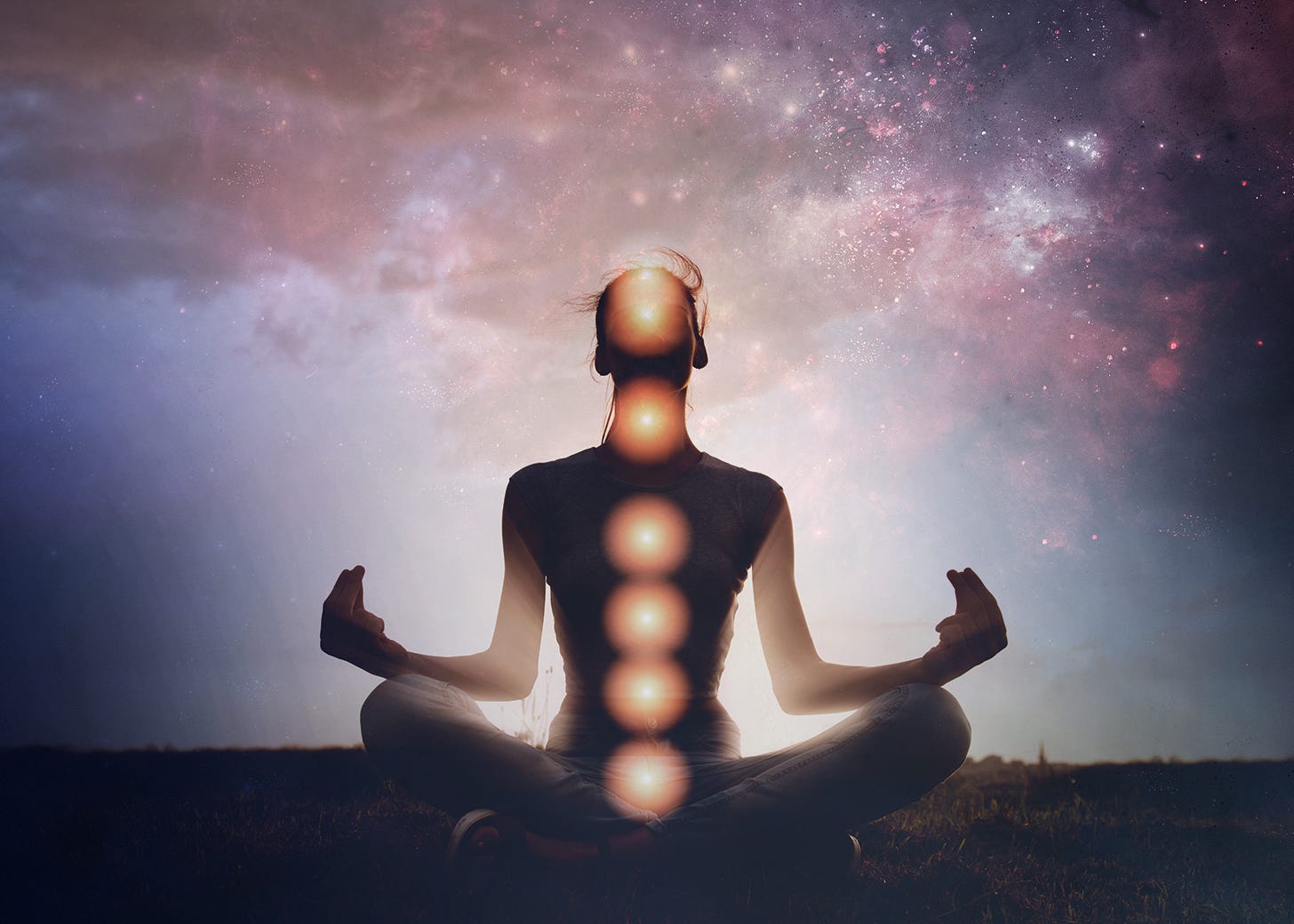
The chakra system is an embodied spiritual system that embraces our inner psychology. The basic seven energy centers each have a location in the body and derive their correlation to the nerve ganglia branching out from the spinal column, and the physiological systems of the body.
The chakras also correspond to elements, such as earth, water, fire, air, sound, light, and thought, all of which occur in the body. Chakras can be accessed through physical practices, such as yoga postures, breathing, and bioenergetic movements, or even dance.
In my work as a somatic psychotherapist, I have correlated the chakras to developmental stages of childhood and their emotional and psychological issues.
My book, Eastern Body, Western Mind, delves deeply into the traumas and abuses that happen at each developmental level, which in turn influence the areas of life correlated to our chakras, such as grounding, sexuality, personal power, healthy relationships, good communication, imagination, and beliefs.
These issues correspond to the areas of the body where that chakra resides, such as digestion being related to our personal power and energy, the legs being related to grounding, or the lungs being related to the heart chakra.
As a spiritual system, the chakras are an integrative system. They provide a ladder of liberation through which we climb up to higher levels of consciousness, incorporating spiritual principles and dimensions. By working through our psychological issues, we free up the energy that gets caught in repetitive patterns, so as to better experience our limitless, divine nature.
But the chakras also give us a means to manifest our highest ideals — as a step-by-step process, coming down the chakras, from mental conception into physical reality. In this way, they are a practical way to embody our spirituality.
Integrative Healing
In my view, no healing is complete without addressing the body, our psychological wounds, and the spiritual aspirations of the soul. Another way of looking at this is combining physical practices, mental beliefs, and the movement of energy or charge.
The chakra system gives you a template for transformation that embraces the full spectrum of the human experience. By integrating all seven of the basic chakras, we unite all of these realms. Healing becomes profound and permanent. We become whole, which is the true meaning of the word heal.
Tools for Practice
Anyone can practice this integration. When a physical issue arises, ask yourself what might lay behind it. Place your hand on that part of the body and notice what the energy there is doing or how it may be blocked.
Consider the chakra that is related to this area of the body. Learn about the psychology of that chakra, and see if its meaning has relevance for you. Employ physical practices to move the energy, psychology exploration to understand the issue, and a spiritual framework to give you a larger perspective.
In this way, every obstacle can become an opportunity for healing, greater awareness, and more aliveness.

Anodea Judith, PhD is the author of a dozen works on the chakras, including the classics, Eastern Body, Western Mind, and Wheels of Life. She is also founder and director of Sacred Centers Academy. She teaches worldwide and has been a frequent teacher for The Shift Network.
Anodiea, I mastered the chakra discipline to understand how opening chakras via re-posturing skeleton may correct vision.
If we decide to open one single chakra, all the rest six would tend to amplify its action in case they are already open.
If we decide to open one single chakra, all the rest six would tend to pull back its action in case they are closed.
The best bet to open chakras is to open them all in one associated chronological sequence one by one, sequentially.