

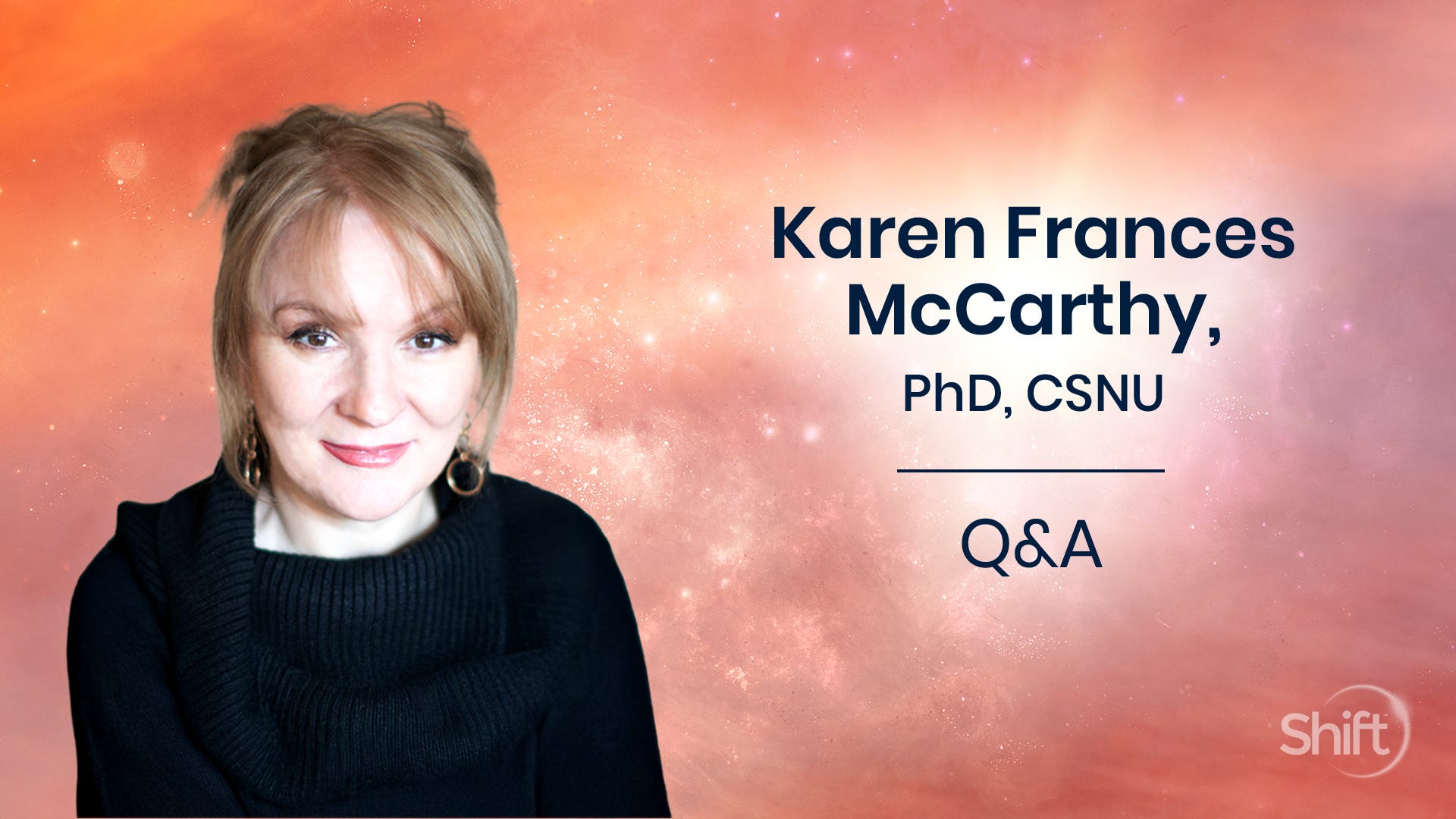
Karen Frances McCarthy, PhD, CSNU, is an Irish scholar, award-holding Spiritualist medium, and author whose work bridges Celtic heritage, consciousness studies, and spiritual connection.
How did your shift from being a political journalist and war correspondent to Spiritualist and medium occur?
My fiancé’s death changed everything. It was not a gentle transition into a new path. It was a rupture. In the early days, I fell back on my training as a journalist. I documented what was happening, researched obsessively, and tried to understand the strange patterns, coincidences, and experiences unfolding around me. I was not searching for comfort. I was trying to find out what was real. That investigative process eventually became my book, Till Death Don’t Us Part. Looking back, grief was the catalyst, but inquiry was the engine. What started as survival became a complete reorientation of my life.
Is there a collision of worlds for you between the respect you’ve earned as a journalist and academic, and the skepticism that spirituality and mysticism often engender?
Yes, there is tension between those worlds. Academia can be dismissive of this field, while spiritual circles sometimes resist scrutiny or structure. I see my role as trying to hold both sides in conversation. Education matters here because there is no governing body setting standards, so responsibility falls on practitioners to pursue training, ethical awareness, and historical knowledge. I am also a strong advocate for challenging and letting go of superstitious belief systems that can cause harm or encourage passivity. My academic background pushes me to question assumptions, and my experiential work keeps the discussion grounded in lived reality. I try to translate between these spaces so the conversation becomes thoughtful, informed, and accountable.
What are the essential things you’d like people to understand about your work and your mission?
If I could choose one thing for people to understand, it is that this work lives inside grief. That means it requires sensitivity, boundaries, and emotional resilience. Practitioners need to care for their own wellbeing, or empathy fatigue becomes inevitable. I also emphasize clarity. Mediumship is not therapy, and it is not about interpreting the living mind. Confusing those roles can cause harm. My mission is to encourage ethical practice, careful training, and emotional steadiness so the work supports people through loss without replacing other forms of care.
What do people in your life, your family and friends, think about what you’re doing?
People close to me responded in very human ways. Some friends thought grief had destabilized me, and pulled away. Others grew closer once they saw how seriously I approached the work. I also found a new community of people whose experiences resonated with mine. Most of my family and friends are supportive because they judge the work by what it does, not by what it is called. A few old friends simply avoid the topic, which is their way of maintaining the relationship. That feels fair enough.
How does your work change people’s perceptions?
What changes most is how people think about death. When they encounter the work in a grounded setting, it tends to move the conversation away from fear or spectacle and toward reflection. People often begin to see loss differently and become more conscious of how they live now. It is rarely dramatic. It shows up later in small shifts, in how they talk about memory, responsibility, and connection. Those quieter changes are the ones that last.
What are the differences between how you and how most other people look at the world?
I do have a different relationship with death, and that reshapes how I see life. Death feels less like disappearance and more like transition. That perspective makes life feel both more urgent and more meaningful. I am more aware of how I spend time, how I show up for people, and what I consider worth investing in. It brings a steadiness that I did not have before. Seeing life through that lens changes the scale of what feels important.
When does your path bring you the most comfort?
The greatest comfort comes from a deep certainty that relationships do not end with death. That removes a great deal of fear from life. What replaces it is not denial of loss, but a different perspective on it. I often feel the presence of the people I love in a way that feels integrated into daily life rather than separate from it. In many respects, I feel closer to them now because the relationship is not filtered through physical distance, time, or circumstance. There is a clarity and appreciation in that connection that I did not fully grasp before. It is a quiet reassurance more than a dramatic experience, but it shapes how I move through the world.
When does it challenge you the most?
One of the harder parts of this path is managing expectations. People sometimes assume I am always available or always tuned in. Mediumship requires preparation and an altered state. It is not something I can or should do casually, especially not on demand in public spaces. Setting those boundaries can be tiring, but it is essential. Without them, the work becomes unhealthy and unsustainable. Another challenge is the emotional load. Working with grief means staying aware of your own limits and recovery needs. I have to be disciplined about rest, study, and stepping back when necessary. That structure keeps the work balanced. It also keeps me honest. Without it, the work risks becoming overwhelming or unfocused, and that serves no one.
Are you sometimes still in awe of what you receive and know, and of the insights and awareness you’ve developed?
Yes. And I think it would be a mistake ever to lose that sense of wonder. What still strikes me is not only the implication that consciousness continues, but how extraordinary life itself is when you begin to see it through that lens. The fact that love endures. The fact that personality, memory, and relationship appear to transcend physical limits. That is immense.
At the same time, it sharpens my awareness of the mystery inside everyday existence. The timing of events. The way people intersect. The depth of human connection. When you recognize continuity beyond death, you start to see how remarkable being alive actually is. The awe is not theatrical. It is a steady realization that both life and what lies beyond it are far more intricate and meaningful than we tend to assume.
Dr. Karen shares the pre-Celtic spiritual wisdom of Tuatha Dé Danann in her exclusive online event with The Shift Network. Learn more here.

Karen Frances McCarthy, PhD, CSNU, holds a Doctorate in English Literature from the University of Birmingham, and is an adjunct faculty member at New York University School of Professional Studies, where she teaches contemporary spectral and speculative fiction. Her academic research explores re-enchantment, postsecular culture, and survival research, with particular attention to the sacred in modern life. She’s the author of Till Death Don’t Us Part and the forthcoming The Re-Enchanted Ghost in Contemporary American Spectral Fiction. Trained at Arthur Findlay College and certified in mediumship, spiritual healing, and grief counselling, she integrates ethical Spiritualist practice, Celtic myth, Zen principles, and scholarly insight into her teaching and guidance. Find her at https://www.karenfrancesmccarthy.com